




Best SEO Extensions for Your Magento E-commerce Store
- 207628 Views
- 4
 SEO Brochure
  Wordpress Brochure
  PHP Brochure
  Magento Brochure
  Redesign Brochure
  Shopify Brochure
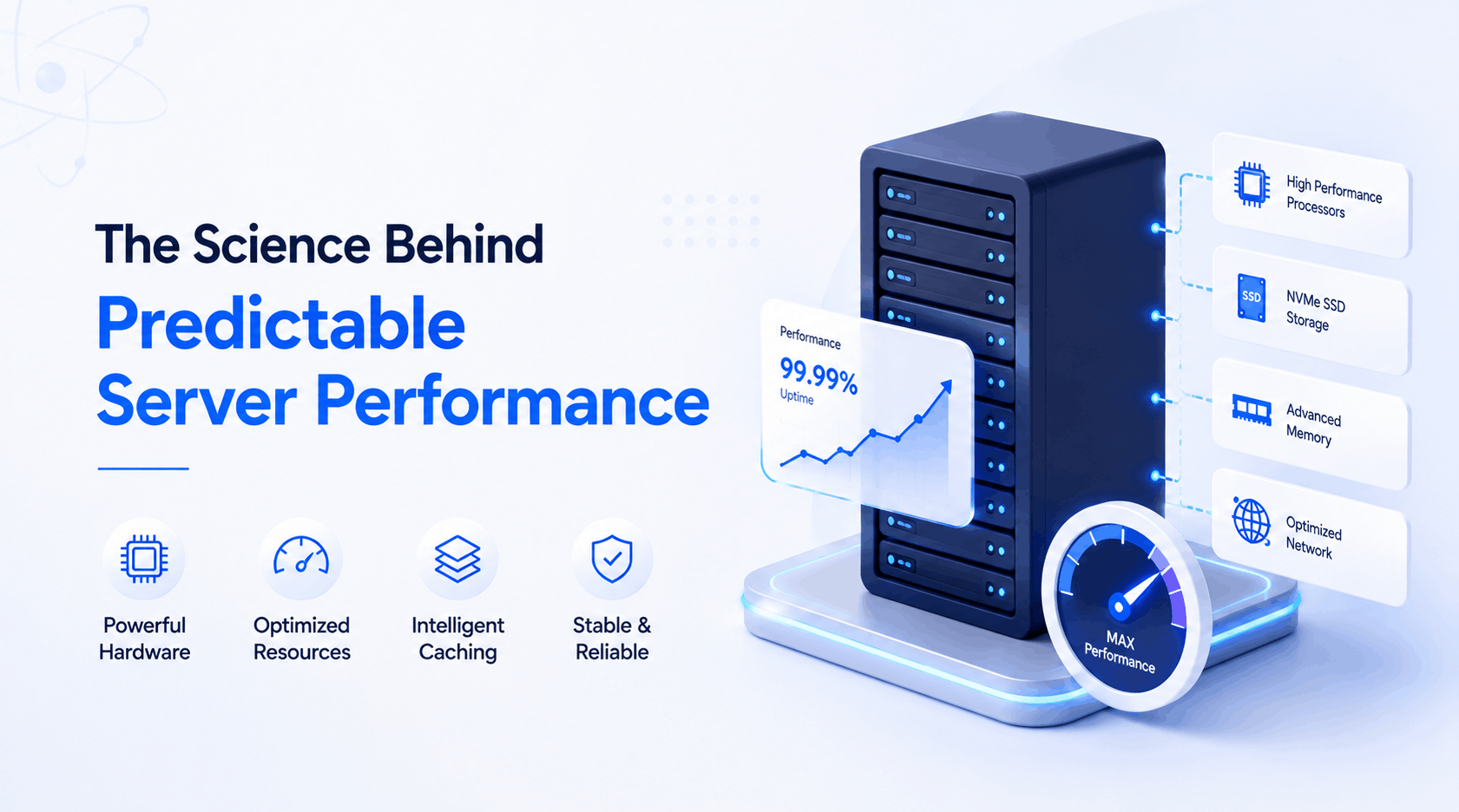
Two servers assembled from identical spec sheets, with the same processor, same memory, and same drive, often answer requests at very different speeds once installed in a live environment. That gap has nothing to do with chance; it traces back to a handful of physical and architectural choices that most providers never mention for a dedicated server with cPanel.
A price comparison built around the cheapest dedicated server in India rarely accounts for any of that. What decides real-world consistency lives underneath the spec sheet, not on it, and the sections below walk through each factor one at a time.
A server that responds in 200 milliseconds one day and 900 milliseconds the next causes more damage than one that remains reliably average, even if that average runs a bit slower overall. A one-second delay in page response has been linked to a measurable drop in conversions in widely cited web performance studies, a figure most business owners underestimate until traffic depends on it directly.
Dedicated hardware works because nothing else competes for it. On a shared server, one account running a memory-heavy script slows every neighboring account instantly. A dedicated environment removes that variable entirely; performance then depends solely on the workload running at that moment, not on unrelated accounts sharing the same physical machine.
Clock speed printed on a spec sheet says nothing about how consistently a core performs once tenants share the same processor. A dedicated core never divides cycles with anyone else, whether the load hits at three in the morning or during a noon traffic spike, which is why identical specifications on two listings still produce different real-world results.
A shared drive processes requests from dozens of unrelated websites at once, and storage speed fluctuates throughout the day as a result. Dedicated storage removes that queue entirely; an NVMe drive reserved for one server delivers the same read and write speed at any hour, regardless of what else runs elsewhere on the network.
A bandwidth number printed on a hosting plan reveals little about how that capacity gets shared once real traffic arrives. An uncontended connection keeps response time steady through a promotional spike, while an oversold one slows exactly when traffic climbs, the one moment a business can least afford it.
Idle conditions make almost any server look better than it performs under real load. A benchmark captured only in that state barely reflects behavior across a full week of uneven traffic. Reliable providers publish sustained load results measured across days rather than seconds, closer to how a website gets used in practice.
A drive approaching the limits of its manufacturer-rated lifespan begins introducing latency long before it fails outright. Providers that route hardware on a fixed schedule catch the decline before clients notice slower response times, while those stretching hardware lifespans to cut costs often pass that decline directly onto the websites that use it.
A synthetic benchmark rarely resembles an actual product launch or a marketing campaign driving unexpected traffic. Testing a configuration against realistic, uneven request patterns exposes bottlenecks that a clean lab number never catches, usually right when a business already depends on the result.
Steady month-over-month performance keeps a hosting budget predictable, since gradual business scaling avoids surprise upgrades mid-quarter. Unpredictable servers tend to force reactive spending, usually at the worst possible time, right as traffic climbs beyond what the current plan comfortably supports, leaving little room to plan the next move calmly.
A single point of failure undermines any claim to predictability, no matter how consistent the hardware performs day to day. Redundant power supplies, RAID-configured storage, and network failover paths keep a dedicated server answering requests even when one component underneath it stops working the way it should, without visitors noticing anything changed at all.
Physical distance adds latency that never appears as a line item on any invoice. A dedicated server priced competitively still underperforms once its data center is located far from the audience it serves; a business targeting visitors within India often gains more from local infrastructure than from a marginally lower price advertised by a distant provider.
A control panel does more than manage files and email. Resource graphs inside a typical panel reveal CPU and memory use over time, letting a team catch a slow decline before visitors notice it. MilesWeb includes this visibility on its dedicated plans without charging extra for tools most providers treat as an upgrade, a detail easy to miss until it becomes necessary.
Predictable performance rarely comes from a single upgrade. It comes from removing every point where one server's problem becomes another's and then measuring the result across real conditions rather than a single benchmark run, across weeks rather than minutes.
MilesWeb builds complimentary professional email accounts and automated daily backups into its hosting plans by default, without treating either as a paid extra. Consistency built into a server this way rarely draws attention, and that lack of attention is usually the clearest sign of performance remaining exactly as predictable as it was built to be. For businesses planning modern digital platforms, combining reliable hosting with scalable AI web development services provides a strong foundation for building secure, high-performing, and future-ready web applications.

Vishal Solanki is an entrepreneur, technology strategist, and the Founder & Managing Director of Future Profilez India Pvt. Ltd. With over 15 years of experience in the IT industry, he has successfully led the delivery of 2300+ digital projects for businesses across 30+ countries.
Passionate about innovation, automation, and business growth, Vishal specializes in helping organizations leverage websites, mobile applications, AI-powered solutions, custom CRM/ERP systems, and digital transformation strategies to scale efficiently.





Ready to bring your project to life? Tell us what you need and we’ll get back with a tailored quote.